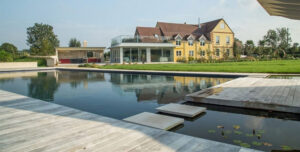

Swimming pools have traditionally been associated with significant water consumption, chemical treatment and energy use. But a swimming pool does not have to come at the expense of the environment. Natural swimming pools offer a different approach, using advanced filtration and natural processes to reduced reliance on conventional chemicals.
At Clear Water Revival, our approach combines bespoke pool design with natural, chlorine-free filtration, creating swimming pools that drastically reduce environmental strain.
What Makes a Swimming Pool More Environmentally Friendly?
The environmental impact of a swimming pool is influenced by how the water is treated, how much water it uses, and how much energy is required to operate and heat it.
Conventional pools typically rely on chemical treatment to maintain water quality, alongside filtration, pumps and heating systems that require considerable energy. Natural swimming pools take a different approach, using biological and mechanical filtration to maintain clean, clear swimming water without relying on conventional chlorine treatment.
This approach can also create opportunities to incorporate planting, natural materials and biodiversity into the garden.
Natural Swimming Pools Blend Into the Garden
One of the most immediate environmental benefits of a natural swimming pool is the way it can be incorporated into its surroundings.
Unlike conventional pools, which often have a distinctly engineered appearance, natural pools can use materials such as stone and gravel to create a softer relationship with the garden. Materials and colours can be selected to complement the local landscape, helping the pool appear as though it belongs naturally within its setting.
Chemical-Free Swimming and a Reduced Environmental Impact
Traditional pools generally rely on chemicals such as chlorine to disinfect the water. Natural swimming pools instead use filtration systems inspired by natural processes to maintain water quality.
Clear Water Revival’s approach uses advanced filtration technology to remove the nutrients that algae and unwanted microorganisms require, helping to maintain clear and naturally balanced swimming water without conventional chlorine treatment.
This means there is less reliance on storing, handling and introducing pool chemicals into the swimming environment. It also means that the nutrients removed during the filtration process can, where appropriate, be reused within the garden as a natural fertiliser.
For a garden designed around natural materials and biodiversity, avoiding conventional pool chemicals can be an important part of creating a more environmentally conscious outdoor space.
Natural Pools Can Use Less Water
Water consumption is another important consideration when assessing the environmental impact of a swimming pool.
A natural pool does not need to be routinely emptied and refilled as part of its normal operation. Once constructed and filled, water levels generally only need to be topped up periodically to compensate for evaporation and other natural losses.
This can significantly reduce the amount of water associated with ongoing pool operation compared with systems that require regular draining and refilling.
Natural Swimming Pools Can Reduce Energy Consumption
Natural pool systems can offer opportunities to reduce energy consumption through efficient circulation and filtration. Clear Water Revival has also developed approaches that allow natural pools to be powered using renewable energy, including solar power for suitable pumping systems.
Heating is another important consideration. An efficiently designed pool can be combined with renewable technologies such as air source heat pumps, ground source heat pumps and solar energy to reduce reliance on fossil fuels.
Air source heat pumps extract heat from the surrounding air and transfer it into the pool, while ground source systems draw energy from the ground. Solar panels can also provide a renewable source of electricity for pool systems.
The most environmentally responsible approach will depend on the property, pool design and available infrastructure, but considering renewable energy from the outset can make a significant difference to the long-term energy requirements of a swimming pool.
Building Natural Pools With Sustainability in Mind
The construction of any swimming pool has an environmental impact, which is why sustainability needs to be considered throughout the project rather than only once the pool is operational.
Clear Water Revival has developed its approach with material selection and construction impacts in mind. We have also introduced carbon-offsetting measures to address emissions associated with pool construction, including tree planting through Carbon Footprint.
Offsetting should not replace efforts to reduce emissions in the first place, but it can form part of a broader environmental strategy when combined with responsible material selection, efficient design and renewable energy.
To get started, reach out to our team today!